Call Us
Hello There!
Sustainable engineering solutions for resource efficiency, profitability, and environmental impact.
Contact Us
-
-
Send Email
info@eribd.com
-
Loading
Sustainable engineering solutions for resource efficiency, profitability, and environmental impact.
Call Us
Send Email
Garment Washing Facility, Bangladesh
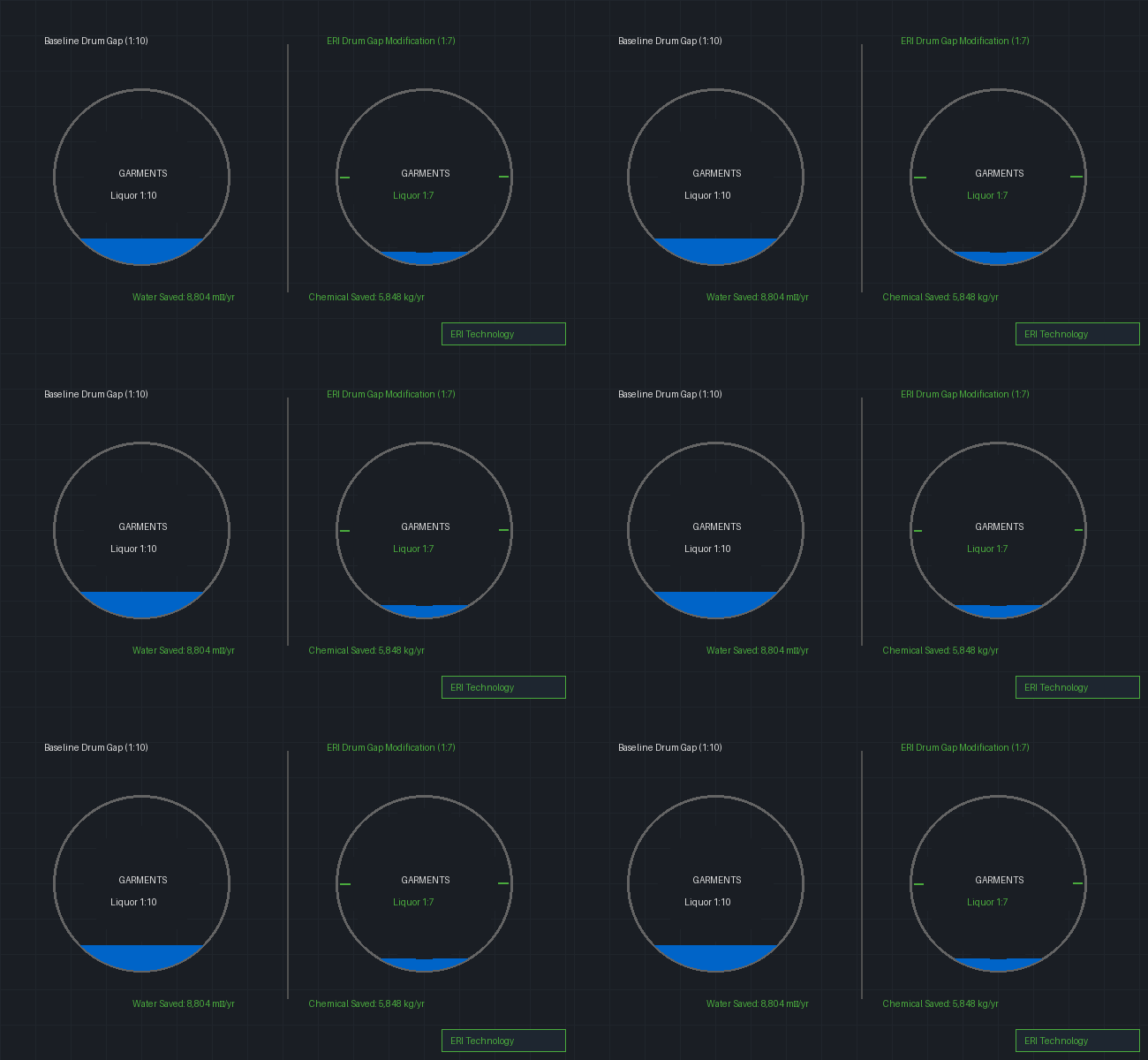
Conventional five-belly washing machines operate at high liquor ratios (typically 1:8 to 1:10) due to a large physical gap between the rotating internal drum and the outer steel shell. This design requires excessive water volumes and proportional chemical loading per batch.
Implemented an in-house mechanical modification. Engineers adjusted the drum position to reduce the drum-to-shell gap, enabling the machine to run at a lower liquor ratio of 1:7 (with 1:6 in progress). This decreased the water bath volume, cutting chemical and water consumption without affecting wash quality.
Drum-to-shell gap causes high water hold-up
Mechanical adjustment reduces drum gap clearance
Reduced water volume per batch achieved
Lower chemical discharge sent to effluent plant
Mechanical gap adjustment executed by in-house engineering team with minimal capital expense.
Cut chemical usage by 6.88 g/kg, yielding $9,064 annual savings.
Extremely low payback period of 1.5 months due to immediate utility reductions.
Successfully validated on two units with roll-out planned for three remaining belly washers.
Adjust parameters to estimate savings for your facility
